Sixteen Channel Sound Distribution System
The Sixteen Channel Sound Distribution System (SDS) is a sound art project to explore sound movement in space. The SDS can select thousands of sound samples and send them to any one or any computation of the sixteen speakers.
The heart of the system is a Raspberry Pi running a custom Python program. For the sound source, I use two Tsunami boards. It has the ability to store over four thousand sound samples and route them to one or any combination of 8 outputs.
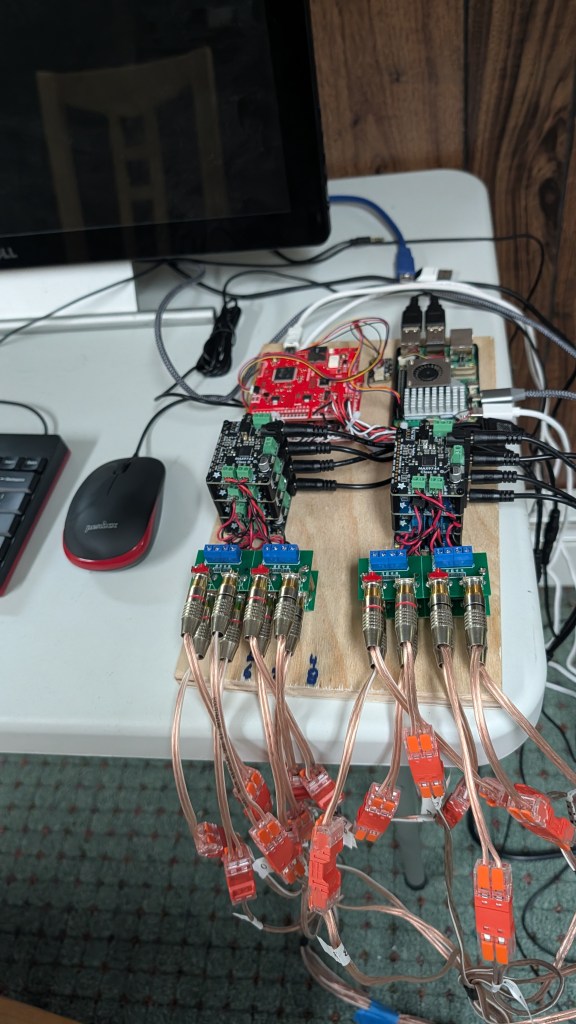
The outputs of the two tsunami boards are connected to eight Adafruit’s MAX9744 stereo amplifiers.
Software
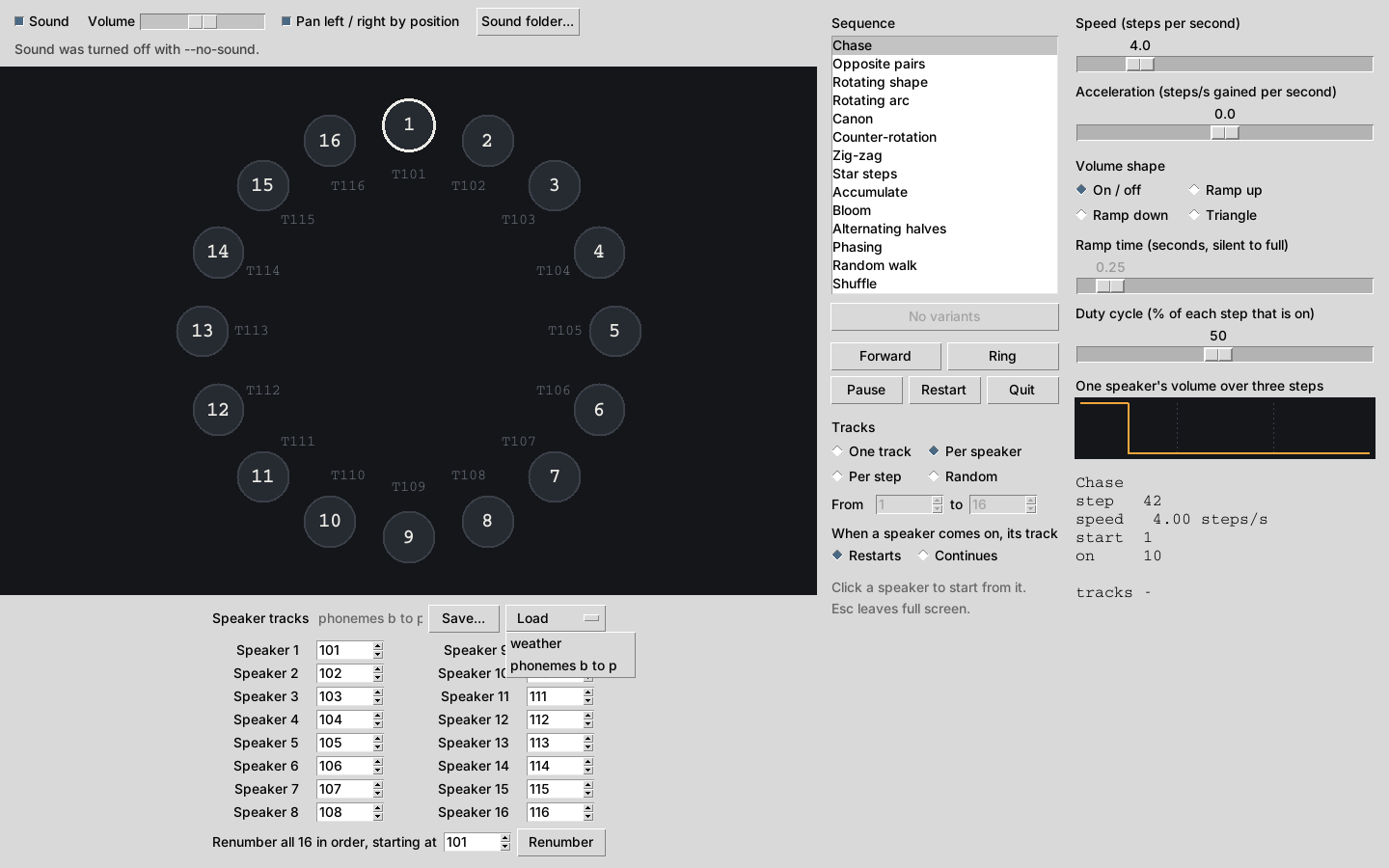
The SDS Sequencer is software written in Python for composing how sound moves through the Sound Distribution System. The arrangement of the speakers could be a ring, two lines of eight speakers or a single line of sixteen speakers.
It includes presets for fourteen speaker movements, from simple chases and rotating pairs to blooms, canons, star patterns, phasing and random walks. Each movement can be shaped by speed, acceleration, direction and starting point. Volume envelopes (on/off with a variable duty cycle, ramps and triangles) set how each speaker swells and fades. Track selection can assign one sound to the whole array, a different sound to each speaker, a playlist that advances step by step, or random choices from a range, and track lists can be saved and recalled by name. Working from files that are loaded onto the system’s Tsunami sound boards, it plays a stereo preview of each sequence, so movements can be heard and refined before they reach the room.